I promised this series wouldn’t be about “secret signals” or fake certainty.
I built JupRunner because I kept seeing the same recycled pitch everywhere: “This bot prints money. Safe. Consistent. No effort.” And meme markets kept teaching the same lesson the hard way:
In meme markets, you don’t lose because your entry was wrong.
You lose because you can’t exit when reality changes.
If you only take one idea from this post, make it that.
This part is the engineering foundation: liquidity, slippage, price impact, routes, rugs, exits — and the structural reasons most bots die before they even reach execution.
Disclaimer: This is not financial advice. Meme trading is high-risk and often irrational. This is a systems/engineering breakdown so you can understand failure modes and build safer, more observable tools.
Quick context (why this series exists)
Part 1 of this series was my response to “guaranteed profit” bot marketing. Meme trading is not hard because it’s mysterious. It’s hard because it’s fast, fragile, and often adversarial.
If you missed Part 1, it’s here: I Built the “Guaranteed Profit” Solana Meme Bot So You Don’t Have To.
This Part 2 is about the primitives that decide outcomes in meme markets — even before you write a single line of “strategy” code.
A 60-second reality check
You buy a meme coin with a small ticket. The quote looks fine.
Then you try to sell during a dump: the route disappears, price impact explodes, fees spike, and your “profit” becomes a loss even if your entry was correct.
In meme markets, execution + exit feasibility are the strategy.
In this post you’ll learn:
- How liquidity depth at your size matters more than charts
- Why slippage is a risk boundary, not a fix
- Why “best price” routes fail in real conditions
- The exit-first checklist that prevents most avoidable losses
Terminology (used in this series)
You’ll see these terms across the posts and in real bot logs/configs. If you don’t share vocabulary, you can’t debug reality.
- Mint
The token’s identifier/address on Solana (the asset address). When people say “don’t trade the same mint twice,” they mean the exact token address. - Pool / AMM pool
The liquidity pool where swaps happen (token A ↔ token B). In AMMs, the pool is the market. - Liquidity (depth)
Not “a pool exists.” It’s how much you can buy/sell at your trade size before price moves against you. Depth is what matters. - Price impact
The price move caused by your trade consuming pool reserves. In thin meme markets, impact is often the dominant cost. - Slippage tolerance
The maximum additional adverse move you allow between quote and execution. It’s a risk boundary, not a “make it fill” switch. - Quote
A computed route + expected output for a given input size and constraints (slippage, max hops, etc.). Quotes can expire or become invalid fast. - Route / hops
The swap path the aggregator picks (e.g., TOKEN → SOL → USDC). Each step is a hop. More hops can mean better price but worse reliability. - Priority fee / compute budget
Fees used to improve inclusion and speed during congestion. Helpful, but can destroy expectancy on small tickets. - ATA (Associated Token Account)
The token account your wallet needs to hold a given SPL token. Creating an ATA costs SOL. On tiny trades, ATA + fees can dominate. - Execution pipeline
The real on-chain process: quote → build tx → send → confirm → read balances → persist result. Each step fails differently. - Exit feasibility
Whether a sell route exists and remains executable under stress. In memes, this is often the main risk. - Rug / liquidity pull
A collapse of tradability/price, often via liquidity removal or engineered dumps. Practically: your exit becomes impossible or catastrophic. - PnL
Profit and loss. The only PnL that matters is net (after slippage, impact, fees, and execution overhead).
Liquidity Is the Product (Not the Price)
New traders obsess over price charts. Engineers obsess over liquidity depth at their trade size. A token can show a “hot” price move and still be basically untradable in any meaningful size.
What liquidity really means (in practice)
Liquidity isn’t “there is a pool.” Liquidity is: How much can you buy/sell without moving price into the floor?
In AMM-based markets (which is basically everything you touch in Solana memes), the pool is the market. Your trade changes the market. So the question isn’t “is there a price?” It’s:
- How much does price move if I try to enter?
- How much does price move if I try to exit?
- Can I exit quickly if the token starts dumping?
The meme-market reality: liquidity is fragile
In memes, liquidity isn’t stable. It’s often:
- thin
- temporary
- manipulated
- pulled
- fragmented across routes
Which means you can have a token that looks like a rocket… until you attempt to sell and discover you’re trading in a puddle. The market didn’t “betray you.” You simply didn’t model liquidity as the product.
Engineering note: Treat “liquidity exists” as an incomplete statement unless it includes (1) your trade size, (2) expected impact, and (3) exit route survivability.
Price Impact: The Hidden Tax That Kills “Good Entries”
Price impact is what your trade does to the price just by existing. This is why two traders can buy “the same token at the same time” and still get very different outcomes.
In thin pools, impact can dominate everything:
- your entry fills worse than you think
- your exit fills worse than you think
- your “signal” can be correct, and you still lose net
Why small tickets “feel safer”… and why they still fail
Small trades reduce price impact, sure. But in memes, small trades can also become structurally meaningless because:
- base transaction fees exist
- ATA creation can be expensive relative to your ticket
- priority fees increase under congestion
- you may pay the hidden cost of retries and failed attempts
So you get squeezed from both sides:
- Large ticket: impact kills you.
- Small ticket: fees + execution overhead can kill you.
This is why “just run it with $5 trades” is not a serious plan unless your system explicitly models fee overhead and failure rates.
Slippage: Not a “Setting,” a Risk Boundary
Slippage tolerance is one of the most abused knobs in crypto bot culture. The lazy approach is:
- trade fails → increase slippage
- trade fails again → increase slippage more
- trade finally fills → you just got wrecked, but “it executed”
That’s not engineering. That’s panic.
Slippage tolerance vs expected price impact
They are not the same thing:
- Expected price impact: what you anticipate based on pool depth.
- Slippage tolerance: what you allow if reality shifts between quote and execution.
If your expected impact is already high, increasing slippage just gives the market permission to punish you harder.
Meme markets are adversarial during execution windows
The critical moment is the gap between:
- “this quote looks good”
- “this transaction is finalized”
In memes, that gap is where traps happen. So slippage should be treated as:
- a guardrail that limits worst-case execution
- not a “make it work” button
Routes, Hops, and the Lie of “Best Price”
On Solana, you usually trade through an aggregator like Jupiter. Aggregators are great — but they operate in a world that changes in seconds. A quote can look profitable and still be unexecutable by the time you act.
Why routes vanish
Routes can disappear because:
- liquidity shifted
- a pool got drained
- the “best path” requires too many hops
- the route becomes too expensive to execute
- a step in the route fails constraints
Best price vs best executability
A “perfect route” that fails 30% of the time is not a perfect route. In memes, you often want:
- fewer hops
- more reliable legs
- stricter exit requirements
This is why serious bots treat route construction like an engineering constraint problem, not an optimization fantasy.
Engineering note: The objective isn’t “best price.” It’s “best price that still executes reliably under stress.”
Rugs, Traps, and “Looks Tradable” Tokens
People say “rugpull” like it’s one thing. In practice, rugs and traps show up as engineering failure modes. You can think of them as categories of “you’re allowed to enter, but not allowed to exit (or not allowed to exit at fair value).”
Common trap patterns (conceptual)
Without getting into exploit recipes, here are the real-world categories:
- Liquidity disappears right after hype entry flows in.
- Exit becomes practically impossible due to route collapse or pool conditions.
- Transfer behavior is hostile (restricted/blocked/controlled).
- Price action is engineered to lure entries then dump through thin depth.
The important framing:
A token can look “fine” on the surface and still be structurally exit-hostile.
That’s why “token security checks” alone don’t solve memes. You need exit feasibility checks.
Exits Are the Whole Game
Most bots are entry-obsessed. That’s why they die.
Why sells are harder than buys
Because exit pressure happens when:
- liquidity is evaporating
- price is falling
- route availability is collapsing
- congestion increases
- you are competing with faster participants
Entering often happens in “optimistic market conditions.” Exiting happens in “everyone is trying to escape.” So if your system doesn’t treat sells as the hardest part, it’s not a trading system — it’s a buy script.
A brutal engineering rule
Before entering, a serious bot should be asking:
- Is there a viable exit route now?
- Is there likely to be one if liquidity drops by X%?
- Can I exit my size without catastrophic impact?
- What happens if the route disappears?
And yes: you can’t predict everything. But you can stop pretending exits are guaranteed.
Why Most Bots Fail Before Execution
This is the part that most Medium posts never admit. Bots often fail before execution because they fail at the “boring” engineering primitives:
Failure class A: they don’t filter candidates aggressively enough
They chase noise seeds and get buried in garbage tokens.
Failure class B: they don’t model exit feasibility
They optimize for entry signals and ignore route survivability.
Failure class C: they treat slippage as “make it work”
They let hostile conditions fill them at terrible prices.
Failure class D: they ignore fee overhead
They run ticket sizes where fee + failure rates destroy expectancy.
Failure class E: they don’t treat the environment as adversarial
They assume stable routes, stable liquidity, stable execution. Memes punish assumptions.
The Engineering Takeaway: Your “Strategy” Is Secondary
Most people want the secret formula. But in meme trading, the real edge is often:
- survivability constraints
- execution reliability
- exit discipline
- visibility into failure
Your “signal” can be decent and you can still lose because:
- you couldn’t execute on time
- your fill was worse than expected
- you couldn’t exit
- your system kept retrying into chaos
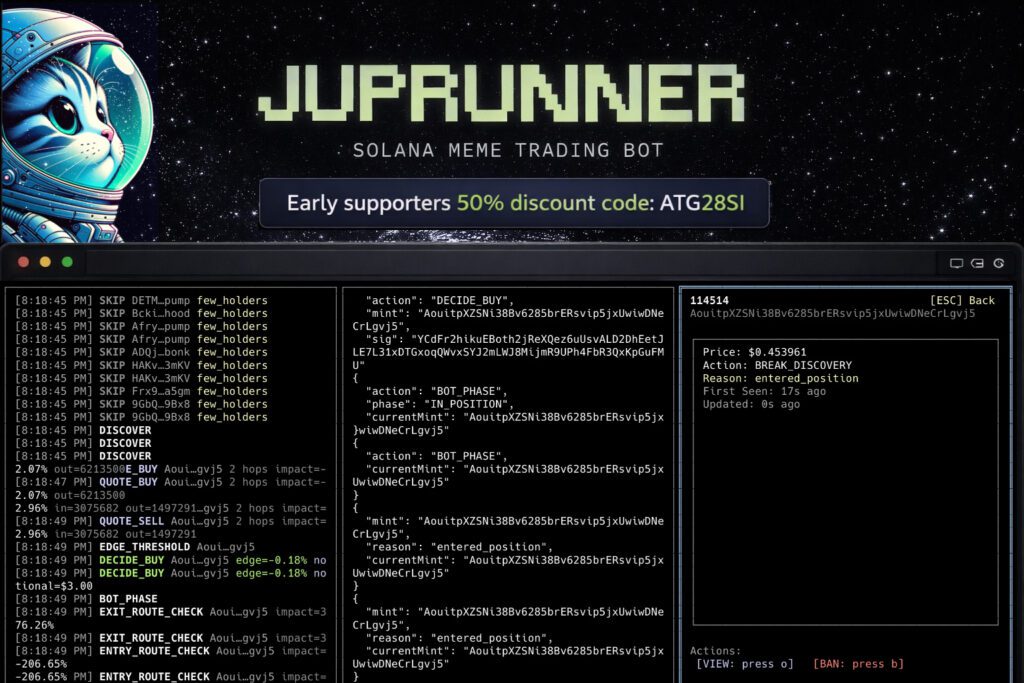
That’s why I built JupRunner as an engineering-first tool — not a “money printer.” It’s designed around questions like:
- “Can we exit this token at all?”
- “What’s the worst-case if liquidity collapses?”
- “Is this trade even worth the fee overhead?”
- “If this fails, will we know why?”
And it logs the answers.
What This Means for JupRunner (and Why It Exists)
JupRunner isn’t trying to be smarter than the market. It’s trying to be more honest about the market. So instead of promising profit, the system focuses on:
- aggressive filtering
- conservative execution assumptions
- exit-first thinking
- guardrails (exposure limits, position caps)
- observability (so you can audit decisions and failure modes)
This is also why the bot forces a very clear mental model:
The job isn’t “find winners.”
The job is “avoid dying long enough to learn.”
The Core Mental Model (Save This)
If you want a single “engineering edition” checklist:
- Liquidity depth at your size matters more than price.
- Price impact is a real cost (often the biggest one).
- Slippage is a risk boundary, not a fix.
- Routes can vanish; fewer hops can be safer than best price.
- Rugs are often exit-hostility disguised as tradability.
- Exits are harder than entries. Plan for it.
- Fees + failures can destroy small-ticket expectancy.
- If you can’t explain why a bot didn’t trade, it’s not observable.
- If you can’t explain how it exits under stress, it’s not a system.
Next in the Series
Part 3 is where we turn this into software: the bot loop, the execution pipeline, and the failure taxonomy—with real logs.
- the professional bot loop (discovery → filters → decision → execution → verification → position management)
- how quotes become real swaps on Solana
- why execution pipelines fail (latency, quote expiry, route changes)
- and how to build logging that tells the truth when things break
Get the Full Bundle with 50% discount
If you want the actual implementation — the codebase, documentation, presets, and prompts — that’s the product.
JupRunner is positioned as:
- Educational source + documentation
- A configurable trading system
- A lab for testing risk controls and execution reliability
- Not a guarantee, not a money printer, not set-and-forget automation
Final disclaimer: Crypto trading is risky. Meme markets are often irrational, adversarial, and structurally exit-hostile. There are no guarantees. If you run anything live, use strict limits and only risk what you can’t afford to lose.