I Built the “Guaranteed Profit” Solana Trading Bot So You Don’t Have To — early supporters 50% discount
February 1, 2026
I kept seeing the same promise repeated across crypto Twitter, TikTok, and even Medium: “This bot prints money. Safe. Consistent. No effort.” So I did the only thing that felt intellectually honest: I built one Solana trading bot from scratch — not to chase hype, but to prove (with real logs, real failure modes, and real constraints) why that promise is almost always nonsense… and what a serious, educational, configurable trading bot actually looks like in the real world.
This post is not financial advice. Meme trading is high-risk and often irrational. This project is educational: it’s about systems engineering, risk controls, and transparency — not “guaranteed profit.”
The post that triggered this project
It started with a Medium article that read like a script:
“Insiders don’t want you to know this.”
“You can make money while you sleep.”
“Just run the bot.”
The tone wasn’t “I built a tool.” It was “I discovered a cheat code.”
And I get why it works. Meme coins are chaotic, and chaos is fertile ground for magical thinking. If you’re new, it’s easy to believe there’s a simple system behind it all.
But one sentence kept repeating in my head:
If this worked the way it’s described, everyone would be running it.
So I stopped reading and started building.
Why “guaranteed profit” collapses in meme markets
The meme coin game isn’t hard because it’s mysterious. It’s hard because it’s fast, adversarial, and often structurally unfair.
Here are the basic realities that destroy “easy money” bots:
You are trading in a warzone of latency
If your bot is reacting to public APIs that are rate-limited or delayed, you’re already late. In meme launches, seconds is an eternity.
Liquidity is the entire game
Meme coins don’t behave like normal markets. Liquidity can appear, vanish, or be manipulated. That means:
price impact can explode
slippage can invalidate strategies
exits can fail when you need them most
Most losses come from not being able to exit
The biggest risk isn’t “wrong entry.” It’s getting trapped: bad routes, no liquidity, honeypots, freezes, or simply a price collapse faster than your execution pipeline.
The market is adversarial
The incentives reward:
bots
insiders
MEV-style behavior
psychological manipulation
Any tool that doesn’t treat this like an adversarial environment is not a serious tool.
So what did I build instead?
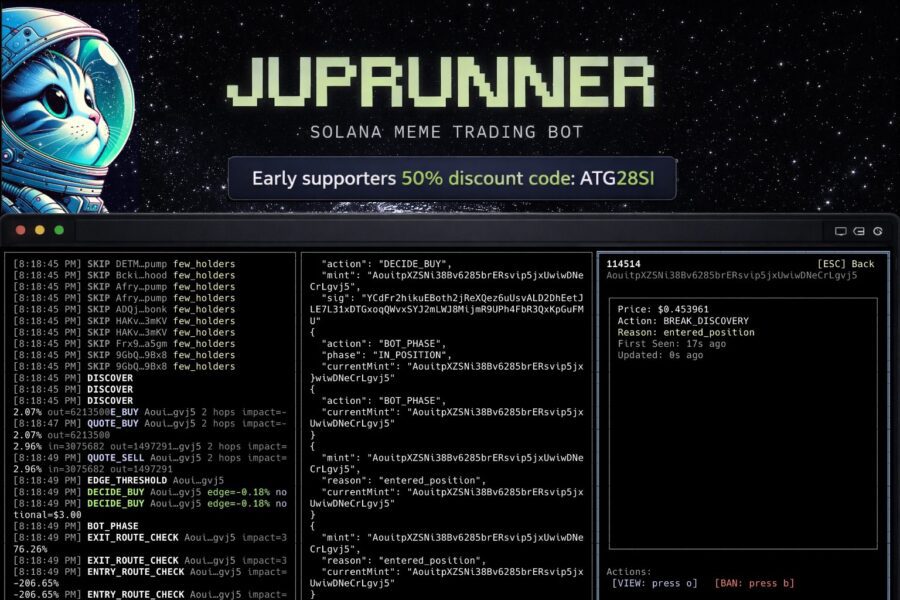
I built JupRunner as a local-first, engineering-first Solana meme trading bot designed for people who want:
real code (not “buy my secret sauce”)
real logs (not screenshots of impossible profits)
real controls (not a black box)
real documentation (not a PDF that says “just run it”)
JupRunner is intentionally positioned as:
✅ Educational source + documentation ✅ A configurable trading system ✅ A lab for testing strategy & risk controls ❌ Not a “money printer” ❌ Not a promise of profit ❌ Not a set-and-forget magic button
The design principles (what makes it different)
Local-first by default
You run it on your machine. You see what it’s doing. You own your environment. No sketchy “hosted bot” with unknown behavior. You don’t need any API or external paid software.
Transparency over hype
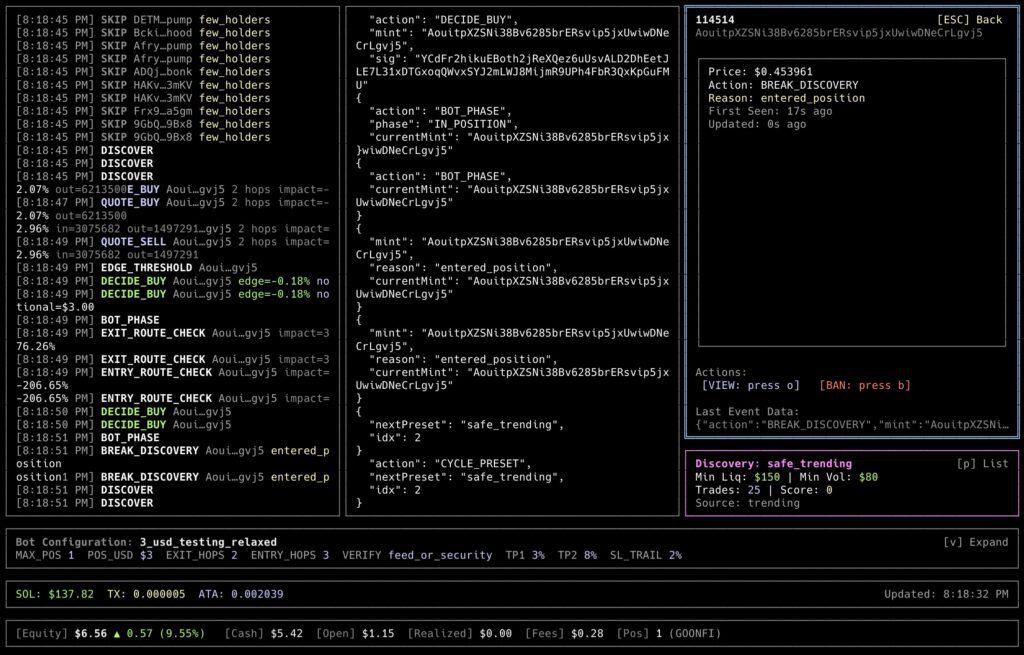
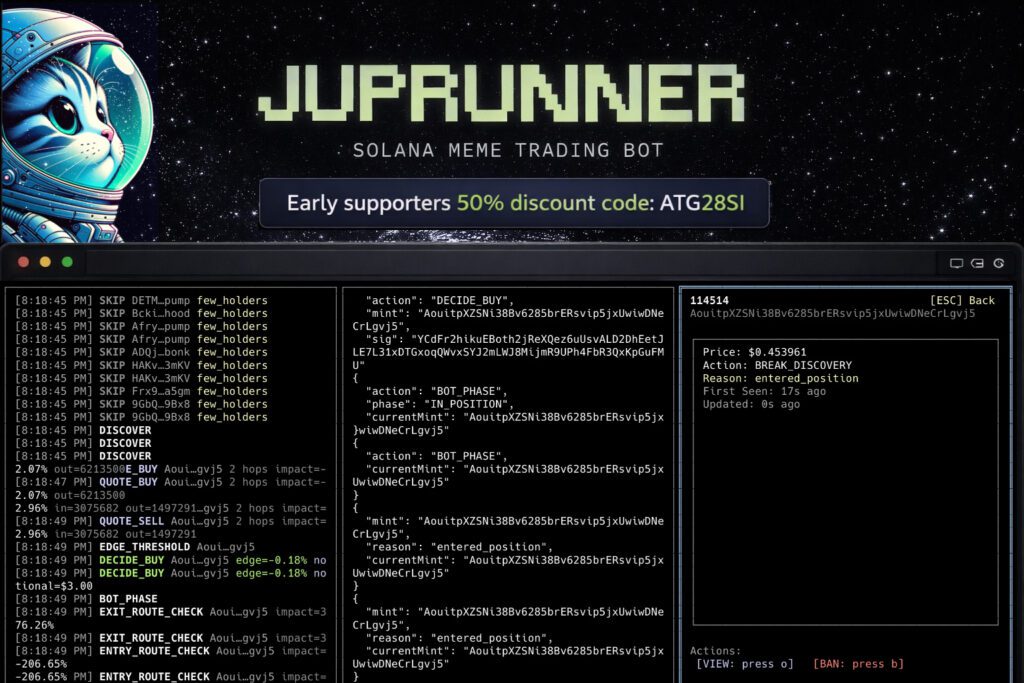
Every decision is logged:
why a token was skipped
what rule blocked it
what the bot saw in the data
what risk limit triggered an exit or prevented entry
If something happens, you can trace it.
Risk controls are not optional
Most bots focus on entering. JupRunner is built around not dying.
That means guardrails like:
maximum open positions
maximum gross exposure
fee buffers
route sanity checks
stop-loss logic (including fast exits when momentum dies)
time-based exits (if the trade stalls or turns)
Everything is configurable
The bot is intentionally full of variables because meme markets change constantly. You need knobs.
You can tune:
discovery frequency and sources
liquidity/volume thresholds
entry edge requirements
route hop limits (entry/exit)
slippage + fee buffers
stop-loss / take-profit behavior
“panic sell” fallbacks
watchlists, bans, cooldowns
You don’t need to edit core logic to change behavior.
What JupRunner actually does (high-level)
Here’s the pipeline in plain English:
Discovers tokens (new / trending / watchlists depending on mode)
This project is for educational purposes. Crypto trading is risky. There are no guarantees. You can lose money fast — especially in low-liquidity meme markets. Always use strict limits and never trade with funds you can’t afford to lose.